Question 5:
Diagram 4 shows the arrangement of homologous chromosomes for two different individuals.

(a) Each chromosome contains a long DNA molecule.
State the content in DNA molecule which determines an individual’s characteristic. [1 mark]
(b) Based on Diagram 4, state the type of mutation experienced by individual Q. [1 mark]
(c) A doctor wants to detect the abnormalities at individual Q during pregnancy.
State two methods that can be used to detect the abnormalities.
[2 marks]
(d) Based on Diagram 4, state
(i) the number of chromosomes for individuals P and Q
(ii) the gender of individuals P and Q.
[2 marks]
Answer:
(a) Gene
(b) Chromosomal mutation.
(c)(i) Amniocentesis method
(c)(ii) Karyotype method
(d)(i) – Individual P : 46 chromosomes
– Individual Q : 47 chromosomes
(d)(ii) – Individual P : Male
– Individual Q : Female
Diagram 4 shows the arrangement of homologous chromosomes for two different individuals.
(a) Each chromosome contains a long DNA molecule.
State the content in DNA molecule which determines an individual’s characteristic. [1 mark]
(b) Based on Diagram 4, state the type of mutation experienced by individual Q. [1 mark]
(c) A doctor wants to detect the abnormalities at individual Q during pregnancy.
State two methods that can be used to detect the abnormalities.
[2 marks]
(d) Based on Diagram 4, state
(i) the number of chromosomes for individuals P and Q
(ii) the gender of individuals P and Q.
[2 marks]
Answer:
(a) Gene
(b) Chromosomal mutation.
(c)(i) Amniocentesis method
(c)(ii) Karyotype method
(d)(i) – Individual P : 46 chromosomes
– Individual Q : 47 chromosomes
(d)(ii) – Individual P : Male
– Individual Q : Female
Question 6:
Diagram 5 shows two examples of factors that produce free radicals and the effects towards P.
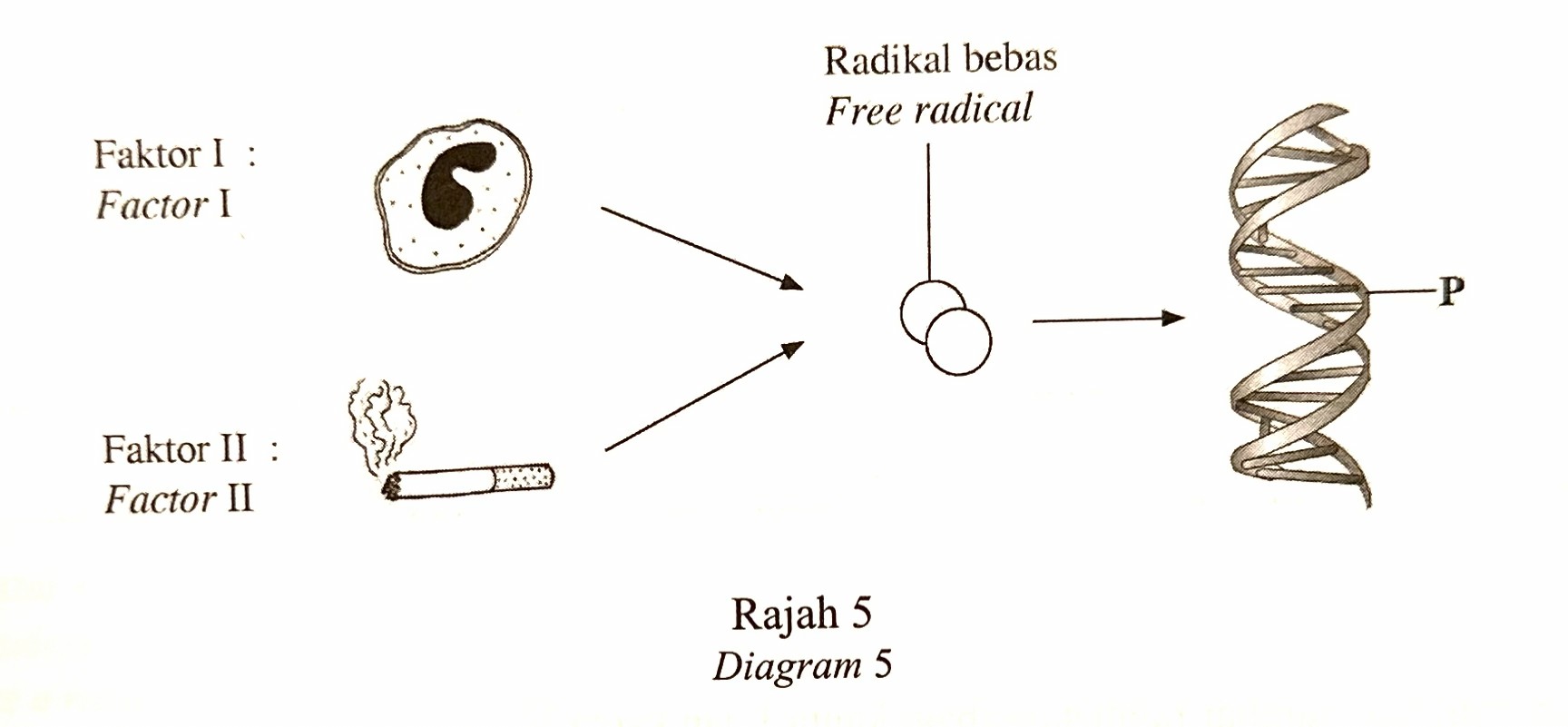 (a) Based on Diagram 5, state
(i) one another example of factor II
[1 mark]
(ii) the effect towards human health when P is attacked by free radicals. [1 mark]
(b) The number of damaged P will increase if preventive measure is not taken.
Suggest one example of antioxidant substance found in food to overcome the problem and its function.
Example of antioxidant substance : …………………………………..
Function : ……………………
[2 marks]
(c) Free radicals can be produced by external and internal factors.
Based on Diagram 5, state which is the internal factor. Give a reason for your answer.
Factor: ………………………………….
Reason: ……………………………………..
[2 marks]
Answer:
(a)(i)
– Air pollution.
or
– Ultraviolet rays.
or
– Ionising radiation.
or
– Toxic waste.
(Any one answer)
(a)(ii) Free radicals damage DNA and may cause cancer
(b)
Example of antioxidant substance:
– Vitamin C
Function:
– Neutralises free radicals and protects DNA from damage.
(c)
Factor:
– Factor I
Reason:
– Factor I shows white blood cells/inflammation occurring inside the body, therefore it is an internal factor that produces free radicals.
Diagram 5 shows two examples of factors that produce free radicals and the effects towards P.
(a) Based on Diagram 5, state(i) one another example of factor II
[1 mark]
(ii) the effect towards human health when P is attacked by free radicals. [1 mark]
(b) The number of damaged P will increase if preventive measure is not taken.
Suggest one example of antioxidant substance found in food to overcome the problem and its function.
Example of antioxidant substance : …………………………………..
Function : ……………………
[2 marks]
(c) Free radicals can be produced by external and internal factors.
Based on Diagram 5, state which is the internal factor. Give a reason for your answer.
Factor: ………………………………….
Reason: ……………………………………..
[2 marks]
Answer:
(a)(i)
– Air pollution.
or
– Ultraviolet rays.
or
– Ionising radiation.
or
– Toxic waste.
(Any one answer)
(a)(ii) Free radicals damage DNA and may cause cancer
(b)
Example of antioxidant substance:
– Vitamin C
Function:
– Neutralises free radicals and protects DNA from damage.
(c)
Factor:
– Factor I
Reason:
– Factor I shows white blood cells/inflammation occurring inside the body, therefore it is an internal factor that produces free radicals.